Michigan offers free dental care to poor kids; more than 400,000 don’t use it
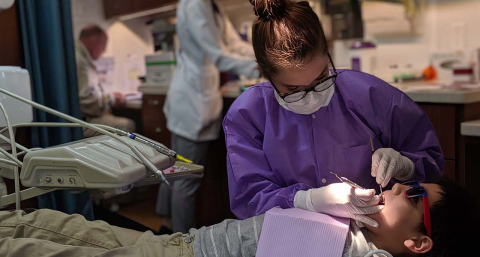
A giant smiling tooth on the outside of this brilliantly-colored clinic recently greeted a steady stream of children from Chester Miller Elementary School, a racially diverse school where 9-in-10 students are economically disadvantaged. Inside the mobile clinic, the sounds of Daniel Tiger, Pinkalicious and the gang of Sesame Street mingle with the whir of polishing tools and suction tubes. Special prizes included sparkly notebooks and stickers.
A line of princess, Spiderman and other cartoon-themed toothbrushes awaited each patient at the end of a visit.
Most kids in this clinic are covered by Healthy Kids Dental. The plan launched in 2000, when the state legislature appropriated $10.9 million to expand access to oral health for Medicaid beneficiaries, with an initial focus on rural areas.
Related: Michigan lawmaker: Require dental screenings for school children
Over the years, Healthy Kids Dental expanded across Michigan until the final three counties – Wayne, Oakland, and Kent – were added in 2015.
Last year, about 56 percent of Michigan’s children on Medicaid visited the dentist about twice, although rates by county vary widely ‒ from more than 76 percent in Charlevoix County near the top of Michigan’s Lower Peninsula to less than 50 percent in Gogebic and Menominee counties in the Upper Peninsula.
The success in Charlevoix and surrounding counties follows a decade of promotion by dentists, the Health Department of Northwest Michigan, schools, social workers, doctors, and even faith leaders who promote health clinics and other health-related campaigns, said aid Dr. Erik Stier, Delta Dental’s Director of Quality Improvement and Utilization Management.
After all, those are the people who know their communities best and can connect with parents. Together, they have raised awareness in the region that oral health is part of overall health – long before oral decay begins to hurt.
Stier said he often tells people: If your teeth and gums were on the outside of the body and you saw what was going on with them, you’d be at the dentist today.
The biggest barrier to healthcare, he said, “is a lack of perceived need. If it’s not hurting or it doesn’t show, it is put on the back burner, especially if you have other things on your mind, like food security or finding a job.”
That means dentists continue to struggle to reach hundreds of thousands of young people who quality for free treatment but don’t make it to the dentist. Poor children nationally are twice as likely to have untreated cavities – 1-in-4 poor children and adolescents, compared with more affluent children, according to the U.S. Centers for Disease Control and Prevention.
One Michigan lawmaker has introduced a bill that would require parents to make sure their children have at least a basic dental screening before they head to school.
Related: Michigan lawmaker: Require dental screenings for school children
Dentists told Bridge obstacles to dental care include lack of transportation, a lack of dentists in some areas with hours that fit families’ work and school schedules, and little understanding among many parents on the importance of dental health.
Building a habit
These dentists also note that most poor, working-age adults in Michigan haven’t had dental insurance for years because Medicaid traditionally hadn’t offered dental care for adults unless they were pregnant or disabled, making it less likely they will seek such care for their children.
Even adults with coverage can had a tough time finding dentists, especially in rural areas. Low reimbursement rates kept all but a few dental offices from accepting patients with Medicaid, said Ruth Kraut, program administrator at the Washtenaw Health Plan in Ann Arbor.
Though more dentists accept Medicaid today, she said, there was a long time when “there were counties where there wasn’t a single dentist to take Medicaid.”
Bottom line: While health clinics like Great Lakes in the Saginaw area or The Wellness Plan in Detroit offer free or low-cost dental care to Michigan’s poor, some habits take a while to catch on.
“If the parents don’t go (to the dentist regularly) themselves, they’re not going to take the child,” said Dr. Michele Bloxson, Dental Director at the Wellness Plan.
link